Shelby Thompson, PhD
I’m a UX Researcher and Designer with a PhD in Human Factors Psychology and nearly 20 years of experience helping organizations make complex systems simple, intuitive, and effective.
My career began in high-stakes, data-intensive environments—most notably at Lockheed Martin supporting work at NASA—where clarity, precision, and usability weren’t just important, they were critical. From aerospace to oil & gas, I’ve worked with highly technical systems, translating complex data, workflows, and constraints into usable, human-centered solutions grounded in research.
Over time, I’ve expanded that foundation into consumer-facing domains, particularly in e-commerce and digital product experiences. What sets my work apart is the ability to bridge deep research with practical design—bringing the same rigor used in complex systems into environments where simplicity, speed, and engagement drive business outcomes.
At my core, I focus on understanding people—how they think, decide, and interact—and using those insights to design experiences that feel natural, purposeful, and clear, no matter how complex the system behind them may be.
Synthesizing multiple sources of insight (such as user research, analytics, or stakeholder input) to define strategic opportunities for a digital product or experience
I regularly synthesize insights from qualitative research (interviews, observations), quantitative data (analytics, surveys), and stakeholder input (product, sales, support) to identify patterns and define strategic opportunities. My approach is to triangulate across these sources—looking for where behaviors, metrics, and business priorities converge or conflict—to uncover the most meaningful areas for impact.
For example, in recent work on retail and e-commerce experiences, I combined user interviews, site analytics, and customer support data to identify where users were dropping off early in the journey. While analytics showed where the problem occurred, interviews and observational research revealed why, and stakeholder input helped frame business constraints and opportunities. This led to reframing the problem from a UI issue to a broader information architecture and decision-making challenge, ultimately informing a more effective, end-to-end solution.
I tend to formalize this synthesis into clear frameworks—journey maps, opportunity areas, or decision models—so teams can move from fragmented insights to aligned, strategic direction.
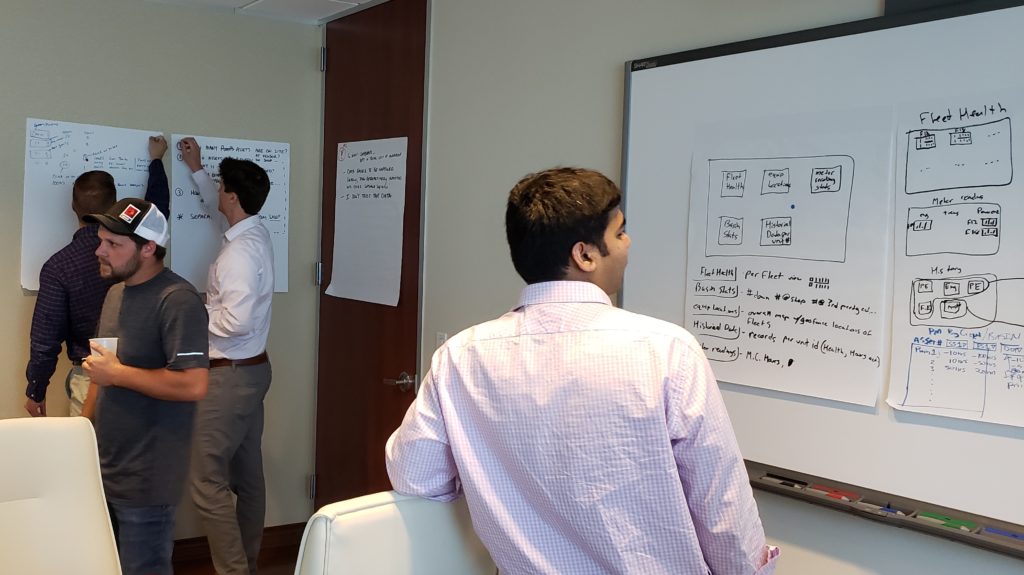
Workshop I led to define a task optimization calendar for Oilfeild Managers.
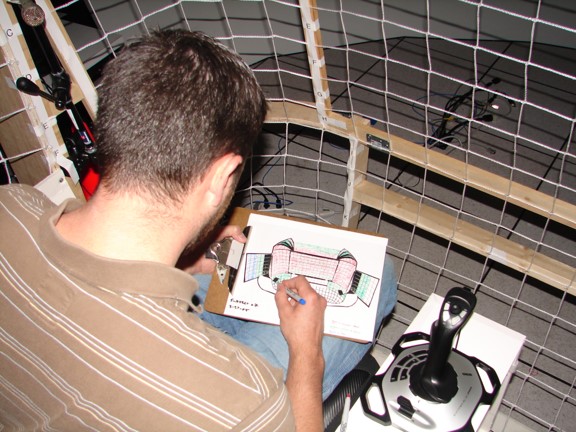
Researh in a lunar simulator to help define window placement and size for a proposed Lunar Rover.
Framing or defining ambiguous problem spaces before design or product work begins
I’m often brought in at the “we know something isn’t working, but we’re not sure why” stage. My role is to bring structure to that ambiguity by defining the problem before jumping into solutions. I typically do this by combining lightweight research (stakeholder interviews, user conversations, analytics review) with synthesis methods that surface patterns, constraints, and unknowns.
From there, I reframe the problem into something actionable—clearly defining user needs, business goals, and key tensions or trade-offs. This often results in artifacts like problem statements, journey maps, or opportunity frameworks that align teams before design begins.
For example, in a recent project, what was initially framed as a need to “improve a feature” turned out—through research and synthesis—to be a broader issue with how users were making decisions across the experience. By reframing the problem at the system level, we were able to shift from incremental fixes to a more strategic redesign that addressed root causes.
I’m comfortable operating in that early, undefined space and see it as critical to ensuring the right problems are being solved.
UX or experience strategy work influencing product roadmap decisions and strategic direction
In multiple roles, my research and UX strategy have directly shaped product roadmap decisions by reframing problems and identifying higher-impact opportunities. For example, in a recent retail engagement, the initial focus was on optimizing a specific feature. Through interviews, analytics review, and journey mapping, I uncovered that the real issue was earlier in the decision-making process—users were dropping off before ever reaching that feature.
By synthesizing those insights, I helped shift the roadmap from feature-level optimization to improving the broader discovery and evaluation experience. This led to reprioritizing work around information architecture, product listing pages, and guided decision-making—areas with much greater impact on conversion.
Similarly, in enterprise and platform work, I’ve influenced roadmap direction by identifying fragmentation across workflows and aligning teams around more cohesive, system-level solutions rather than isolated fixes. In these cases, UX strategy wasn’t just informing design—it was helping determine what should be built and why.
I’m comfortable operating at that level, where research and experience strategy guide prioritization, sequencing, and long-term product direction.
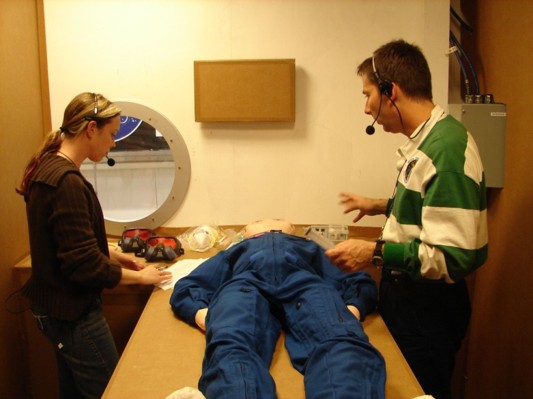
Investigation of emergency medical operations for a lunar habitat.
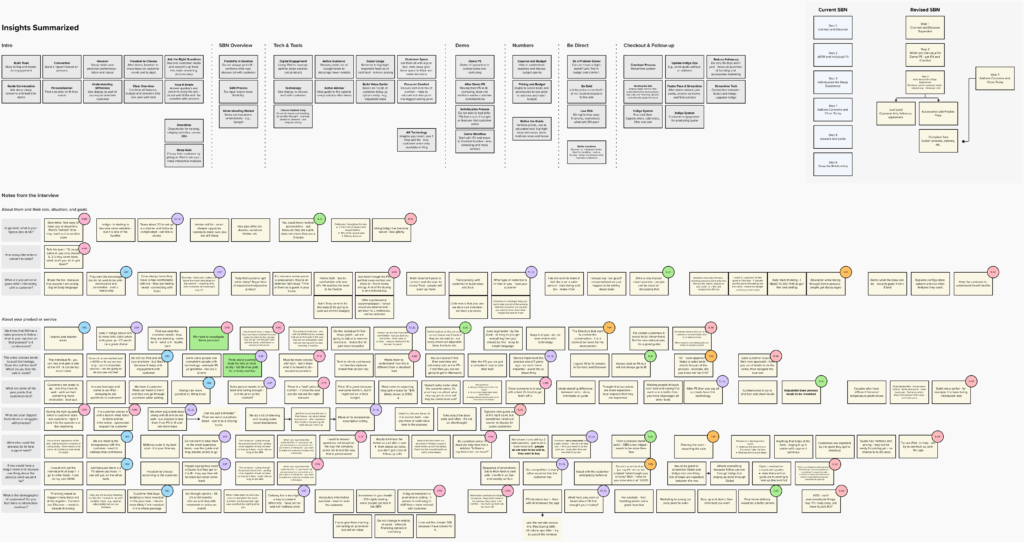
A journey map with defined areas of opportunity for design. This was then voted on by stakeholders.
Creating strategic UX artifacts such as journey maps, opportunity frameworks, ecosystem diagrams, or information architecture models to guide product teams
Across my projects, I regularly develop journey maps, personas, opportunity frameworks, ecosystem diagrams, and information architecture models to bring clarity to complex problem spaces. These artifacts aren’t just deliverables—they’re tools to align teams, surface gaps, and guide decision-making.
For example, in a recent retail engagement, I created end-to-end journey maps that highlighted where users were dropping off and why. This helped shift the team’s focus upstream to earlier decision-making moments, ultimately influencing both design direction and roadmap priorities.
In enterprise and platform work, I’ve built ecosystem diagrams and IA models to untangle fragmented systems—helping teams understand how different tools, roles, and workflows connect. This often leads to identifying redundancies, misalignments, and opportunities for simplification at a systems level.
I also use opportunity frameworks to translate research insights into clear, prioritized areas of focus, making it easier for product and engineering teams to act. My goal is always to make complexity visible and actionable, so teams can confidently move forward with a shared understanding.
Using AI tools to support research synthesis, design thinking, or prototyping workflows
For research synthesis, I use AI to rapidly cluster themes from interviews, summarize large datasets (e.g., survey responses, support logs), and identify patterns that I then validate and refine through human judgment. This significantly accelerates time-to-insight while maintaining rigor.
In design thinking, I leverage AI for ideation—generating multiple directions, exploring edge cases, and pressure-testing concepts. It’s particularly useful in ambiguous problem spaces where breadth of thinking early on leads to stronger solutions.
For prototyping and communication, I use AI to help draft flows, generate content variations, and support rapid iteration of concepts before moving into higher-fidelity design in tools like Figma. I’ve also worked alongside engineering teams using AI-assisted development tools, which has reinforced the importance of clear design intent and precise communication.
Importantly, I see AI as an accelerator—not a replacement. I use it to move faster and explore more, but I rely on my experience in research methods and human-centered design to ensure outputs are meaningful, accurate, and actionable.
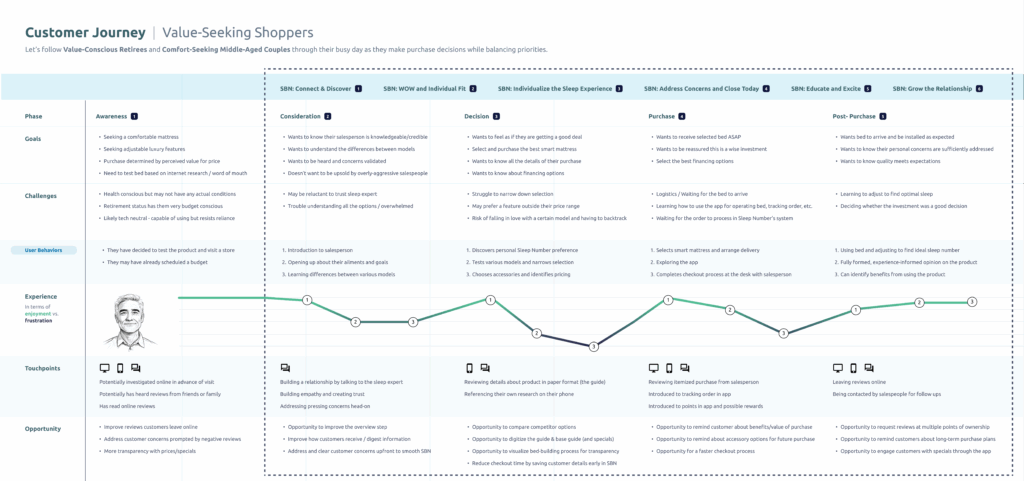
An example persona and journey map that utilized AI to help synthisis research into a final product.

Using Figma to create high-fidelity mockups used to get stakeholder sign-off and to pass along to development for creation.
Align multiple teams (e.g., product, research, design, analytics) around a shared experience vision or strategic direction
I’ve worked across product, design, research, analytics, and business stakeholders to align teams around a shared understanding of the problem space and a clear experience direction. My approach typically starts with bringing everyone into the same picture—synthesizing research, data, and stakeholder input into artifacts like journey maps, opportunity frameworks, or north star concepts that make the problem and path forward visible.
From there, I facilitate working sessions, critiques, and workshops to co-create solutions and build alignment, rather than handing down recommendations. I’ve found that alignment happens more effectively when teams participate in shaping the direction.
For example, in a recent project, multiple teams were working on different parts of the experience with little coordination. By mapping the full ecosystem and user journey, I helped identify fragmentation and overlapping efforts. We then aligned around a shared experience vision and restructured priorities to focus on cohesive, end-to-end improvements rather than isolated features.
I’m comfortable acting as that connective layer—translating between disciplines, aligning priorities, and ensuring that strategy is understood, supported, and carried through execution.